By Avah Avonda
Hello, NERRds! My name is Avah and I am spending my summer at the Guana Tolomato Matanzas NERR as a research intern. I had the opportunity to take part in many moving projects here at GTM and I would like to share them here! Let’s look at my highlights of the summer.
Marsh Monitoring at Pellicer Creek
My first real involvement at GTM was marsh monitoring. I joined Hans Prevost and Jacob Berna as a scribe while they assessed various vegetation throughout Pellicer Creek near Faver-Dykes State Park. It was a four-day job. How do you monitor vegetation? Let me tell you, because now I know. There are several marked sites along each of the three transects built into the marsh of the creek. Pellicer Creek is special because it encompasses an array of landscapes along a winding bank and salinity gradient, therefore there is plenty of biodiversity to monitor. At each site, a large quadrat is used to assess percent cover of every species found. Then, the tallest 5 plants of each species are measured, and these measurements are taken as canopy height. This monitoring takes quantitative measurements that can be compared to years of past and future data. It was a great opportunity to be involved in such a massive long-term project and to go further into Pellicer Creek than I ever thought I would. Yes, it was hot. Yes, I almost passed out, but I would do it again. Being so close to a NERR in action and learning about vegetation that had been just under my nose was an amazing experience.


SWMP
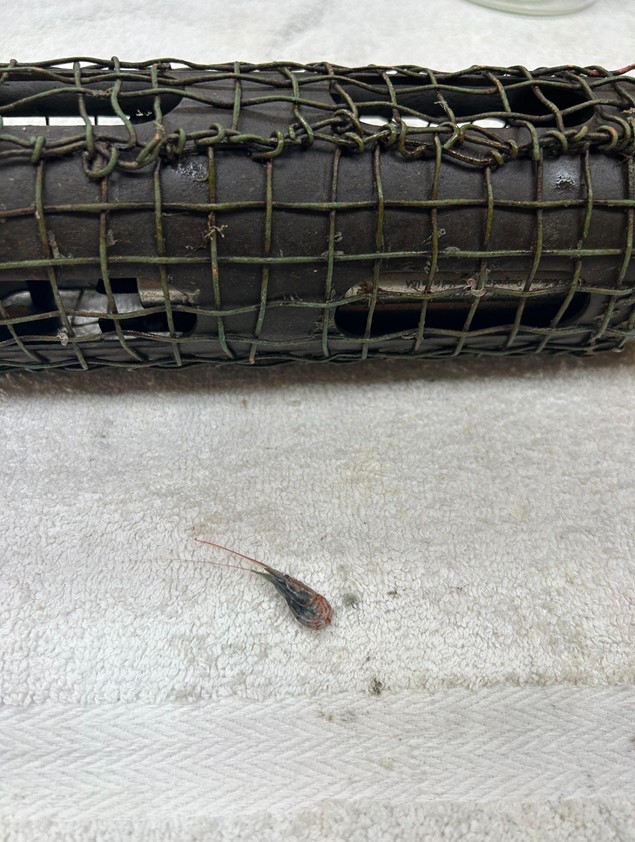
I spent most of my time here at GTM with SWMP manager Shannon Dunnigan. She was such an amazing help during my internship and taught me the ropes of SWMP. What is SWMP? The system-wide monitoring program. Read more about this program and see SWMP data here: https://gtmnerr.org/research/weather-and-water-quality/. Shannon took me once every two or three weeks on a boat named Bertha to swap data sondes. These bad boys take a massive amount of data at sites along waterways of the reserve. These are located on channel markers in the San Sebastian River, around Pine Island and Fort Matanzas, and also in Pellicer Creek. A guard protects the individual sensors of the sonde from biofouling and the elements, but sometimes I saw a peppermint shrimp or even a couple of crabs. Once, I saw this baby fish with some bite power.

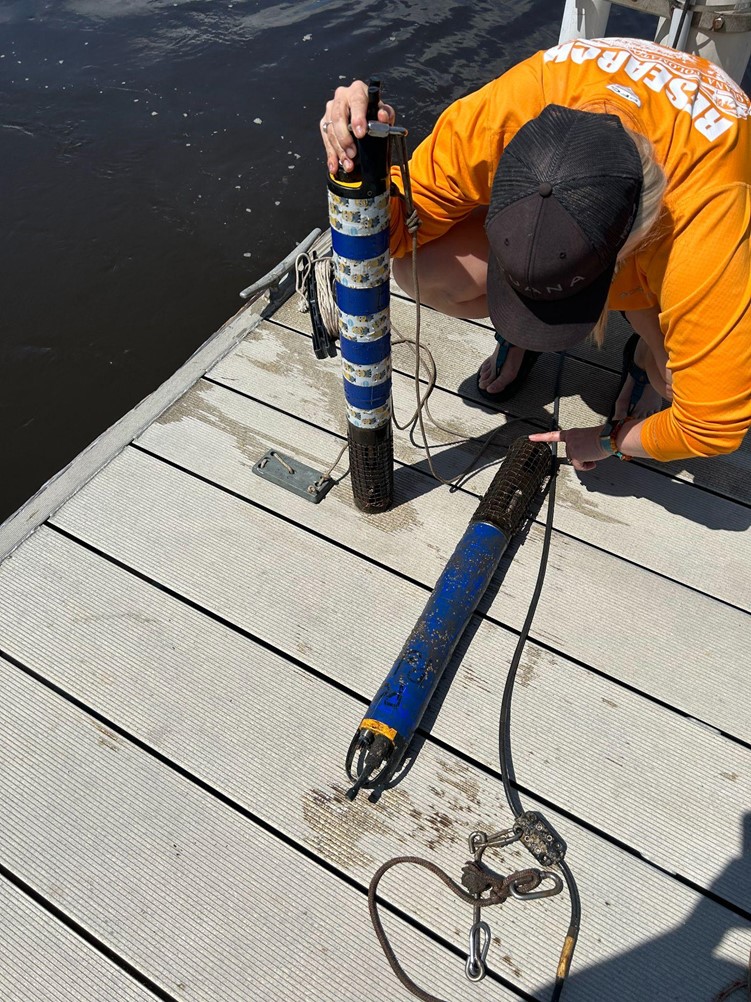

These sondes need to be calibrated before deployment to make sure the sensors take proper data to the right standard. Each sonde also needed to be post-calibrated and cleaned within 24 hours to verify that the data taken isn’t skewed beyond a certain criteria. If a post-calibration of a sensor is too off, it is time to troubleshoot and determine if the whole dataset can be submitted to NOAA or of use to anybody. This is handled by Shannon and Katie Petrinec (SWMP Data Specialist). I learned how to calibrate and post calibrate and even did some on my own!
Every month, SWMP has a nutrient grab day. On these, we take Bertha to each site and take water samples with what is known here as “the straw”. One side is plugged and suction allows water from under surface water to be collected. After, we put this water in its respective bottles, pack them, and send them to the Florida DEP lab to be analyzed.


PMN
The Plankton Monitoring Network (PMN) is a volunteer-led effort and I had the opportunity to spend some of my mornings with these citizen scientists. I met many amazing volunteers including the head volunteer, Trihn. Learning about plankton surrounded by helpful hands and good hearts was an incomparable experience.
With PMN, I opened my eyes to the crazy microscopic world of plankton. I plankton towed at two sites and learned to identify different plankton, recognize behaviors, and understand plankton types through a microscope. My favorite: the copepod zooplankton. They look like godzilla crawfish on the slide and I even witnessed one eat a phytoplankton. I got a first look at some troublesome phytoplankton and their effects. During my time at PMN, I saw quite a bit of Pseudo-nitzschia. These stick-looking diatoms create a toxin that accumulates in shellfish, making them not safe to eat for humans as well as fish and mammals.


Ranger Surveys
Within my internship, I had the chance to collaborate with the Ranger department and take part in biological surveys. These were focused on amphibians, reptiles, and shorebirds. On amphibian surveys, we dipnetted for tadpoles and frogs in our high-fashion waders. With the help of Zach, Kayla, and Savanna, I gained first-hand experience in identifying tadpole/frog species and even their calls! This summer, I was constantly impressed with rangers’ knowledge of these small differentiations. I saw tadpoles with hind legs, a mud turtle, massive pig frog tadpoles, and water snakes. Where else would you face your fear of snakes if not holding them in their natural habitat?


When I accompanied herpetofauna (reptile) surveys, the focus now turned to snakes. I witnessed traps and was taught the reasonings behind them. Traps made of chicken wire were placed along tarps because snakes naturally like to be against something. A damp sponge is placed inside the trap so that if frogs are trapped overnight, they have moisture. When all is said and done, palm leaves are placed on top to provide shade. A perfect formula for a snake. When I was out, rangers found multiple pygmy rattlesnakes. These tiny critters have a beautiful color pattern and are so small that I didn’t even hear the rattle!
The other survey I attended was shorebirds. I accompanied rangers and volunteers walking along all of GTM’s beach accesses with a set of binoculars to identify birds on shore and off. Once again, I gained identification knowledge as well as an awareness of shorebirds. I will never walk a beach again without noticing birds and their behavior. This opportunity has enlightened me on an integral part of the coastal system. I even saw a killdeer and her nest! Killdeers nest in sand dunes and in order to protect these nests, they will fake a wounded wing in order to draw away perceived threats. I witnessed this behavior first-hand, and it was a phenomenal experience. Rangers found her nest and reported its location to Florida FWC for its further protection.


TAG
I had the opportunity to attend GTM’s quarterly Technical Advisory Group (TAG) meeting. Stakeholders, community members, and scientists come together in the education center of GTM’s south Ponte Vedra office and discuss ongoing projects and concerns of the community. This was such a great meeting to experience because I got to witness the cross between science and the community. Many great projects were presented, including bivalve research, research on nutrient effects in estuaries from urban influxes, and creating a comprehensive map of data from the open waterways within the reserve. There were also presentations from The Matanzas Riverkeeper as well as projects from the University of Florida to create an easily-accessible website with all comprehensive data from the Guana estuary. Project teams and organizations took this time to involve community members and other scientists to give opinions and viewpoints of their efforts.
Aquatic Preserve Guana Run
During my internship, I also got the opportunity to shadow Jessica Lee, a water quality technician with the Aquatic Preserves. This was very similar, yet very different to my nutrient runs with SWMP on Bertha. This instead focused on waterways within Guana and its surroundings: Guana River, Guana Lake, and Mickler’s Landing. We took a boat out to Guana Lake, double filtered the samples, and poured them into designated bottles to send to a lab for analysis. GTM coordinates with FWC to take samples in the Guana River via airboat. I had only ever imagined an airboat ride in the Everglades! I saw wildlife up close (including alligators) in an empty waterway of the reserve. It was an amazing experience, and all while learning about GTMNERR.


About the Author

Avah Lena Avonda is a soon-to-be graduate in May 2025 as an Environmental Science major with minors in Agricultural and Natural Resource Law as well as Soil and Water Science. She attends the University of Florida where she pursue her interests in environmental policy and the science that supports it. Concepts such as nutrient influx and agricultural impacts are some of her favored topics. Over the summer of 2023, she was a research intern at GTMNERR in Northeastern Florida. She witnessed the scientific process in action and participated in many moving research projects hosted by one of 30 national estuarine research reserves in the country. This opportunity allowed her to engage in the fundamentals of conservation and she will always value the lessons she has learned.
 NERRds on the Water