
Hello NERRds! My name is Michelle Moczulski and I recently graduated from Villanova University with a B.S. in Environmental Science. For my senior thesis, I worked with Drs. Samantha Chapman and Adam Langley to examine a 38-year water quality dataset collected from 13 water monitoring stations throughout the Guana Tolomato Matanzas National Estuarine Research Reserve (GTMNERR).
These awesome long-term data sets make it possible to ask whether nutrient levels have changed in bodies of water over the past few decades, during a time when urban development increased in St. Johns and Flagler Counties. Excess nutrients entering water can cause harmful algal blooms, induce seagrass death and cause harmful effects on fish and other organisms. Thus, I examined water quality with a focus on the nutrients nitrogen (N) and phosphorus (P) parameters and investigated seasonal and annual trends and differences among the 13 stations.
Check out the StoryMap summarizing the project!
The water quality data I analyzed was collected by GTMNERR and St. John’s River Water Management District (SJRWMD) from 1986 to 2022. The waterways of GTMNERR are euryhaline, meaning they encompass a wide range of salinity. I examined nutrients in water bodies that have <20 ppt and >20 ppt salinity. I distilled almost four decades of data into annual means and looked at monthly averages to assess seasonal patterns in water quality that may arise due to precipitation patterns and one-time events, such as hurricanes. Using ArcGIS Pro, I conducted a distance weighted interpolation to detect spatial patterns in water quality across the Reserve. I then produced a land-use change map to further examine how changing landscapes around the GTMNERR may be correlated with water quality.
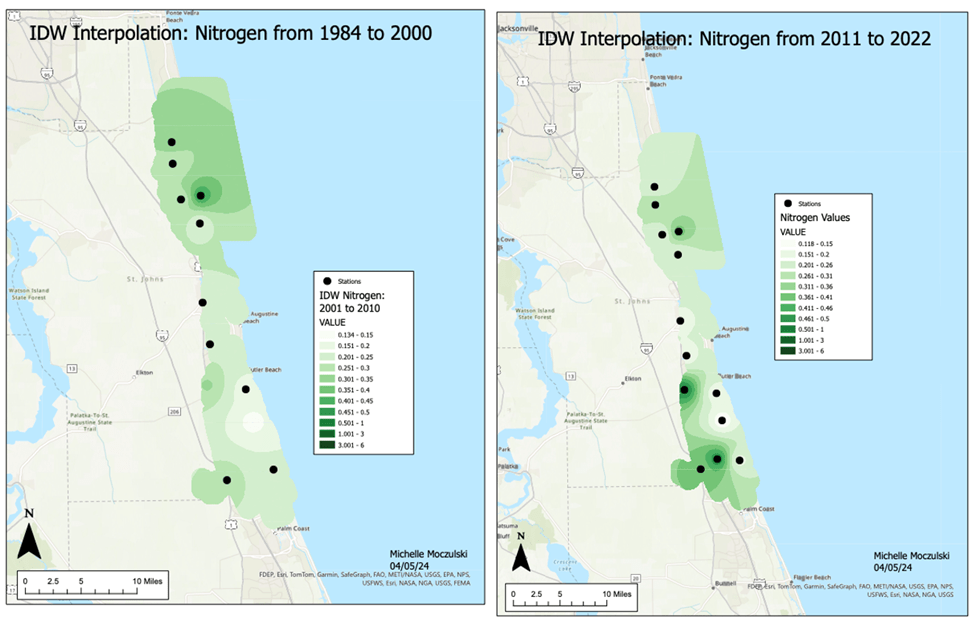
My data revealed that N and P concentrations in water were typically higher in inland water bodies than coastal ones (Maps 1 and 2). Inland water quality stations could be more impacted by anthropogenic stressors such as run-off from impervious surfaces (like asphalt roads and parking lots), agricultural, and human wastewater while coastal water bodies are often surrounded by coastal wetlands and oyster reefs that filter water. Additionally, ocean influences can dilute changes in water quality with tidal exchange. I found that nutrient levels were more affected by seasonality and one-time events, rather than year-to-year variability. During the wet season in Florida (June to September) and during hurricanes, increased precipitation runoff transports nutrients into waterways. N levels were high near the Pellicer Creek and Guana River water quality stations (Map 1) and P levels were highest near Pellicer Creek (Map 2). The geospatial model indicated that total phosphorus decreased from the 1984-2000 time period to the 2011- 2022 time period (Map 2), and the annual graphs indicate that ammonium decreased over time at high salinity sites (Story Map Figure 1). N and P reductions over time could be attributed to the Clean Water Act. This study suggests that nutrient levels in the reserve fluctuate seasonally and spatially, and to a lesser degree, over the long-term. Therefore, it is important to monitor changes at a wide range of stations and work to manage N and P at the local scale.


Michelle Moczulski graduated from Villanova University in May 2024 with a B.S. in Environmental Science and worked on her senior thesis with GTMNERR, which she hopes to publish in a scientific peer-reviewed journal. She currently works at Environmental Resources Management as a Consulting Associate Scientist, in Manhattan NYC, where she monitors groundwater and soil quality for various clients in the tristate area. When she isn’t out in the field or working on her paper, she likes to escape the city and enjoy the ocean on Long Island.
 NERRds on the Water