
By Hallie Fischman
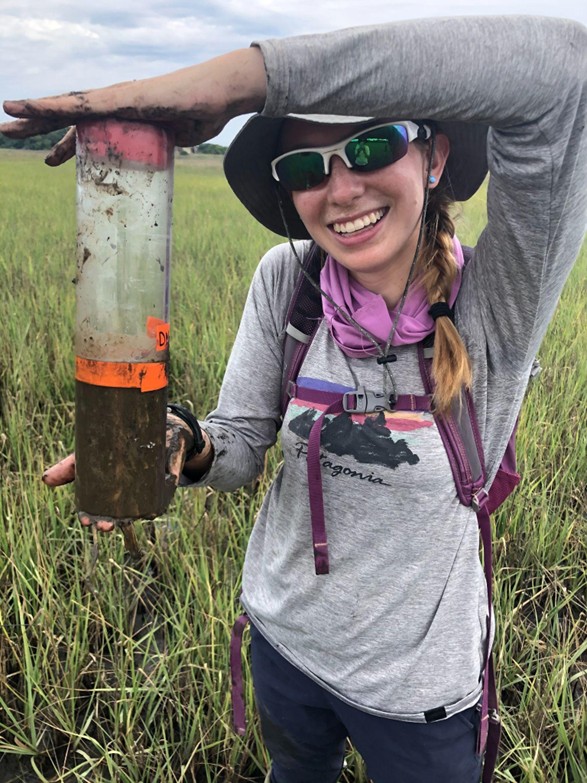
Hello! My name is Hallie Fischman and I recently completed my PhD at the University of Florida, where I worked in the Guana Tolomato Matanzas National Estuarine Research Reserve. My PhD work at the GTMNERR evaluated the potential of ribbed mussels Geukensia demissa and eastern oysters Crassostrea virginica to remove nitrogen and carbon from the water.
On one of the first fieldwork days of my PhD research, I walked the marshes of the Guana River with my advisor to brainstorm some experiments and identify possible study sites. During this scouting exercise, we noticed something surprising: marshes on the eastern side of the Guana River had large numbers of mussels while the marshes on the western side had relatively few mussels and many crushed mussel shells scattered on the marsh surface. We also observed evidence of rooting and wallowing, suggesting that the invasive hog Sus scrofa was consuming the mussels at this site. This observation led to a multi-part study on how predation of mussels by hogs alters marsh communities, nitrogen processing, and sediment trapping.
As mussels are a foundation species that provide important connections throughout the whole marsh ecosystem, we hypothesized that the reduction in mussel populations would have cascading effects to the entire marsh community. While not part of my initial PhD plan, this hog study seemed like an essential first step. How could we assess mussels as a nutrient remediation tool without understanding why the mussel populations were reduced in some areas?
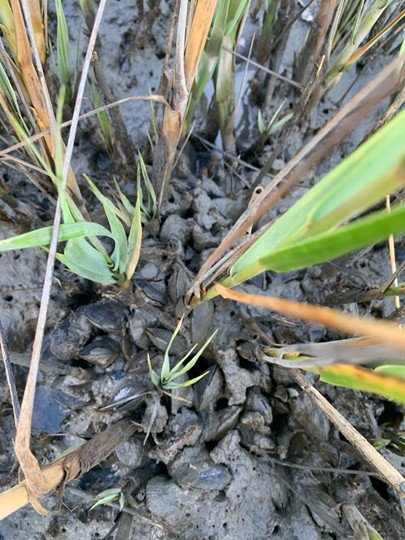
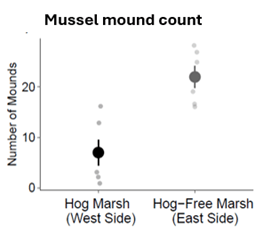
Over the next two years, I led several hog-mussel studies including field surveys, hog exclusion experiments, and measurements of sediment denitrification (the process whereby microbes remove nitrogen from the water and release it back into the atmosphere). This work showed that hogs reduced mussels on the western marshes of the Guana River by 93% compared to the eastern marshes. Within the western marshes, mussels placed in hog exclusion cages survived for several months, while mussels outside of cages were eaten within weeks, confirming that hogs were driving this pattern.
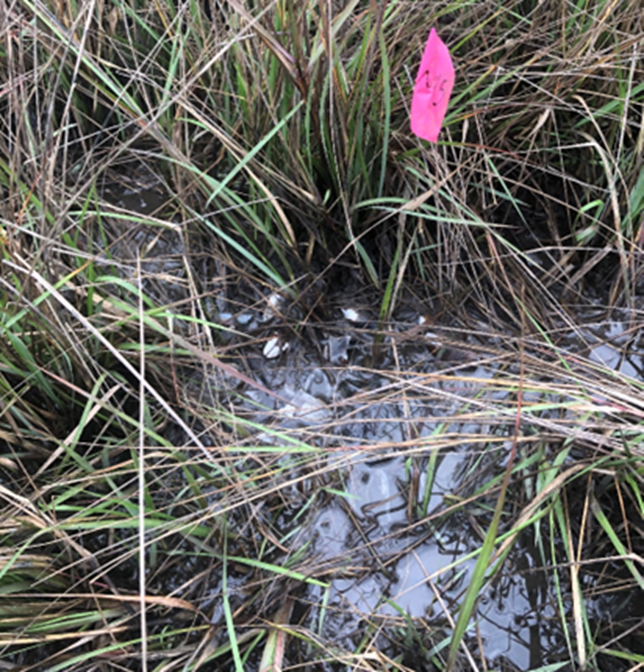
We suspect that hogs are active in the western marsh because that site is bordered by a hardwood hammock forest within a wildlife management area, while the eastern marshes are bordered by houses, a narrow dune, and highway A1A. Hog presence led to trampled marsh cordgrass, and a reduction in marsh crabs, marsh elevation, and sediment accretion, all of which are detrimental impacts to marsh functioning. But, we also noticed that in untrampled areas at hog-accessed locations, cordgrass was taller than in hog-free marshes, likely due to the release of nutrients from trampled grasses. And, hog trampling stimulated sediment denitrification, leading to permanent removal of nitrogen from the system. Hog management has been an ongoing discussion in the GTMNERR and throughout the Southeast US for decades, and our findings revealed many negative impacts of hogs in salt marshes, but also some surprising positive effects.
This wraps up the first part of my PhD research—stay tuned for part two where I quantify the nutrient cycling of mussels and oysters!
 NERRds on the Water