By Hallie Fischman
Hello! It’s Hallie again sharing part 2 of my PhD research. Last week, I wrote about my unexpected foray into wild hogs and how my research showed that hog consumption of mussels alters marsh communities, sediment trapping, and nitrogen cycling. Read it here if you missed it. After wrapping up that work, I transitioned back to my initial project plan: assessing the amount of nitrogen and carbon taken up and stored by mussels and oysters throughout the Guana River.
Nitrogen and carbon are essential nutrients that fuel estuary productivity, but the Guana River has an excess of nutrients. In 2022, Florida Department of Environmental Protection determined that Guana River does not meet state water quality standards for nutrient concentrations. My research was part of a NERRS Science Collaborative-funded project designed to help address the nutrient problem. The project team included University of Florida faculty, students, and GTMNERR staff. Check out the project page to learn more.

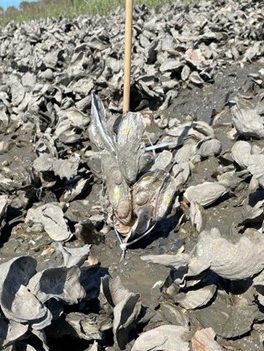
Like many estuaries, Guana River contains a gradient of environmental conditions. Upstream, where freshwater runoff enters the estuary, we see lower salinity and higher nutrient concentrations. Downstream, nutrients are lower and salinity is higher due to tidal flushing. This environmental context likely influences the growth, distribution, and nutrient storage capacity of resident oysters and mussels. To quantify these patterns, I used the GTMNERR’s annual oyster monitoring dataset, conducted on-the-ground bivalve surveys, measured oyster reef and salt marsh area from drone imagery, transplanted individually tagged mussels and oysters to calculate growth rates, measured the nitrogen and carbon content in bivalves across the estuary, and calculated the annual nitrogen input to the estuary from runoff. When combined, these datasets revealed species-specific differences and hotspots of nutrient cycling throughout the Guana River.
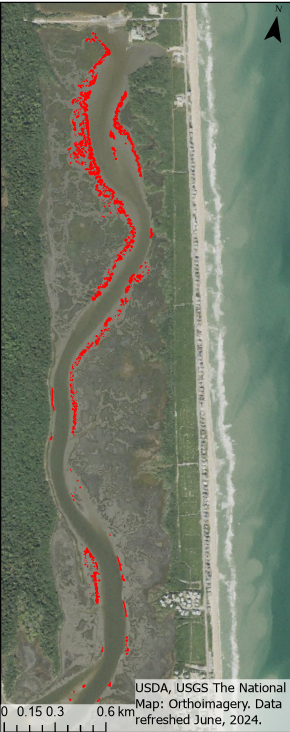
Across the entire Guana River and its marshes, there were nearly 10-times more oysters than mussels (likely in part due to the hogs!) and oysters grew 50% faster than mussels. Both species occurred at higher densities upstream than downstream and oyster growth was faster upstream while mussel growth was faster downstream. In total, naturally occurring bivalves assimilated 11% of the annual particulate nitrogen input to this estuary, suggesting that bivalves are a feasible nutrient remediation tool but must also be coupled with nutrient reduction strategies on land. As bivalve nutrient assimilation was 5-times higher upstream than downstream, our results demonstrated that bivalve restoration aquaculture efforts should prioritize oysters and be concentrated upstream to maximize the nutrient assimilation return-on-investment. Using a back-of-the-envelope thought experiment, we estimate that clustering oyster restoration aquaculture cages upstream where nutrient inputs and oyster growth is higher can increase nutrient assimilation 27-44% compared to evenly dispersing cages across the entire estuary.
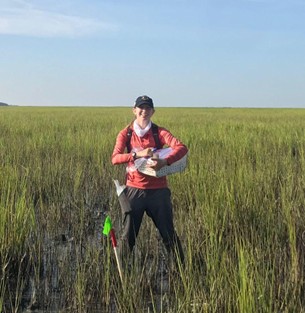
These two projects focused on the Guana River, but the findings have implications for hog management, bivalve restoration, and nutrient mitigation plans in the region. On a personal note, this work allowed me to spend hundreds of hours in the incredible marshes and oyster reefs of the Guana River. I had some perfect days where the weather was beautiful and the marshes looked like postcards, and some hilarious days with torrential downpours, hundred-degree heat, or when the golf cart died and I had to push it back to the ranger station with the help of strangers out for a hike on the trails. But the opportunity to work at the GTMNERR and with the GTMNERR team on projects with real-world applications was a truly amazing experience that made all the long days worth it!
 NERRds on the Water